Sunday, 1 April 2012

Kensington Gardens

Another lovely garden in the middle of downtown. Everyone was out enjoying the fine weather and watching the swans on the lake.

 Early daffodils of spring.

 Playground envy! You can actually climb up into the crow's nest of this ship. On the downside, you have to wait on line (!) to get into the Princess Diana Memorial Playground. I took this picture through a fence.

 Kensington Gardens lake.

One of many preening swans.


Nice of the crown to provide lawn chairs.

Natural History Museum

London's Natural History Museum is housed in a magnificent, Victorian-era building across the road from the Victoria and Albert museum. I particularly liked some of the detailing in the architecture - lots of fun animals crawling all over the place.


 The building is so large it's hard to find the right angle for a photo. The museum takes up an entire city block. 

 Dinosaur on the window ledge? Not sure what this creature is (picture taken on maximal zoom), but I like 'im.

 If you look carefully, you can see lots of animals perched around the perimeter of the roof.

 Just inside the main entrance.

 Monkeys swinging around the ceilings.

Monkeys climbing the walls.

Glyptodon. Now extinct about 10,000 years, these guys are cousin to the armadillo and the ostrich egg.


Models of dodo birds made by a 17th c. man who actually saw dodos. They're surprisingly big! It stands to reason, then, that this is not he exaggeration I always though it was:

Alice and the Dodo Bird, original drawing to go with Lewis Carroll's classic.


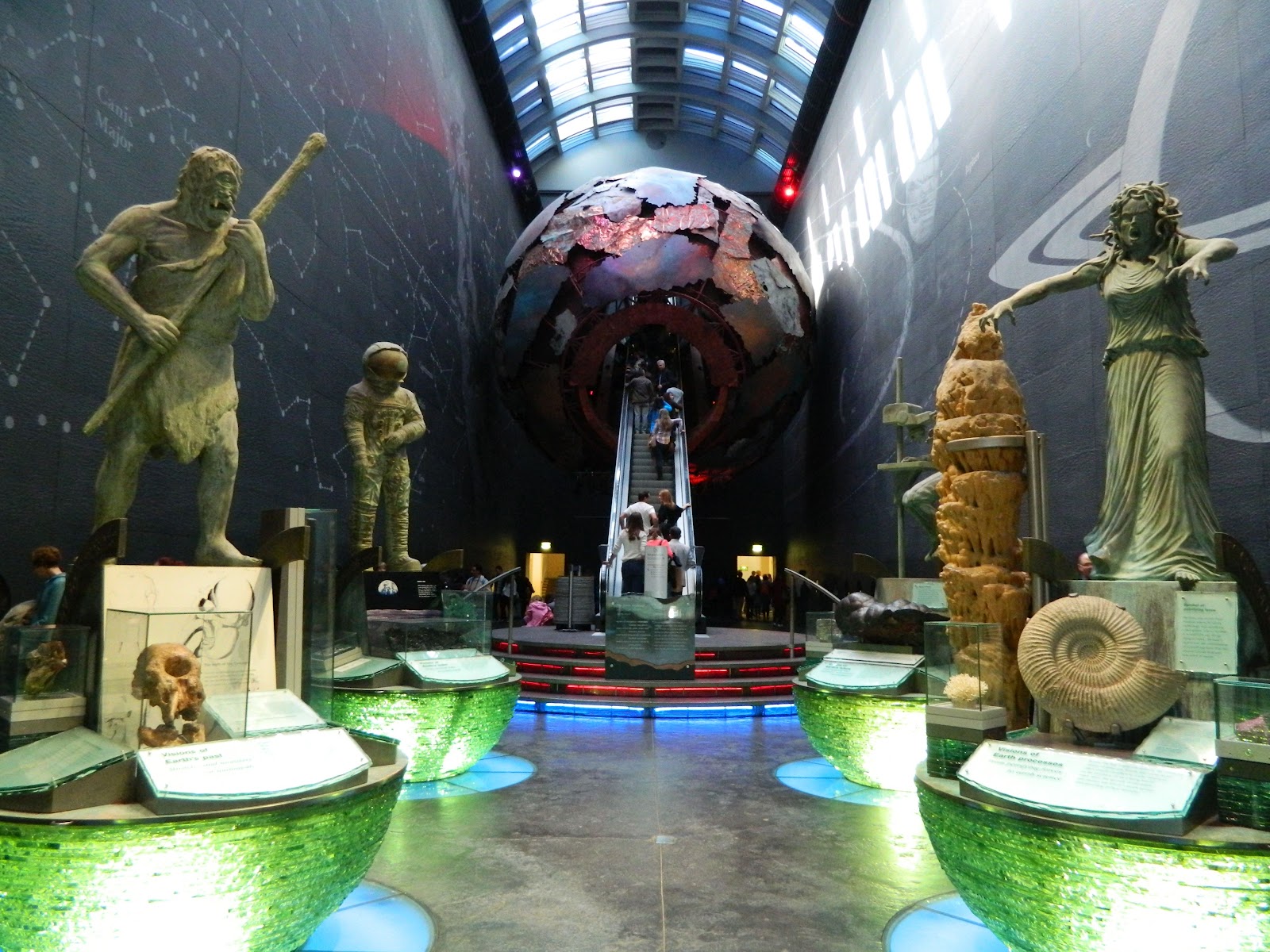
Entrance to the exhibit on earth science (volcanos, etc.). You get to ride up this escalator through the "earth" globe which glows all coppery. Very glitsy, not terribly substantive.

Portobello Road

Those who remember the lyrics to the most memorable song in Disney's 1971 flick Bedknobs and Broomsticks might recall these verses:

Portobello road, Portobello road
Street where the riches of ages are stowed.
Anything and everything a chap can unload
Is sold off the barrow in Portebello road.
You’ll find what you want in the Portebello road.

Rare alabaster? Genuine plaster!
A filigreed samovar owned by the czars.
A pen used by Shelley? A new Boticelli?
The sniper that clipped old King Edward’s cigars?

Waterford Crystals? Napoleon’s pistols?
Society heirlooms with genuine gems!
Rembrandts! El Greco’s! Toulouse-Lautrec’s!
Painted last week on the banks of the Thames!

etc.etc.
That about sums it up. Mordu was especially amused by the "vintage" sign for the London 2012 Olympics - pre-corroded for your convenience. Unfortuantely, I didn't take a picture of that. But I did take a few others.


Sunday, 25 March 2012

Bath

Readers of Jane Austen might be interested to learn that Bath, a popular vacation spot for 18th century British gentry, has actually been populated since the Iron Age. It is the site of natural hot, sulfurous springs and the Romans built a lavish bathhouse there in the 1st century. It is also home to the magnificent Bath Abbey, built in the 10th century. Today, it is still a major vacation destination, bustling with shops and museums. The city and surrounding countryside are both charming.

 Front of Bath Abbey.

 Close-up of the ladder with angels on Bath Abbey.

 Roman Baths.

The water in the Roman baths is untreated so only the ducks get to bathe there. Humans can go to one of the many spas in town.

Source of the hot water spring.
It's difficult to see in the picture, but the water is steaming.
 What remains of the facade of the temple to Minerva that was part of the bath complex. This facade is an unusual mixture of Roman and Celtic motifs. It is also one of the few Roman antiquities in England that is not imported from elsewhere.

 Bath pigs decorated by various artists all around the city. Why pigs? Perhaps because of the tradition of pig farming in the area.

 City green space. The whole city just invites relaxation!
Table and chairs at a cafe called "The Mad Hatter's Tea Party"

Stonehenge

I was excited to see Stonehenge and it did not disappoint; in person, it was every bit as majestic as I had hoped. The site is located in a rural area at the intersection of two single-lane roads with no buildings in sight - only sheep and mysterious burial mounds that looks small, artificial hills (many ancient graves have been discovered in the vicinity of Stonehenge). You are not permitted to approach, but may walk 360 degrees around the monument. I went a little overboard taking pictures of the rocks, but you probably have seen enough generic photographs of Stonehenge. So here are just a few pictures of us taken from various angles.


Windsor Castle

Windsor Castle was built by William the Conqueror in the 11th century as one of several fortifications ringing London at a distance of about 20 miles (equivalent to one day's march). For nearly a millennium, it has served as living quarters for the British royals. Queen Elizabeth II, for example, spends her weeks at Buckingham Palace but her weekends at Windsor.

A large fire in 1992 destroyed several of the important public rooms - most of them part of the state apartments lavishly decorated in the 19th century by the various King George's. As luck would have it, the crown found a way to raise funds to repair the damage: charging admission to tourists.

Unfortunately, we were not allowed to take pictures inside the castle. The photos taken outdoors are from my camera, but those taken inside were swiped from the internet.


Aerial view of the castle. (Shh....I didn't take this picture either.)

The exterior of the castle looms over the town of Windsor.

 The round tower, which flies a flag when the Queen is in residence, is surrounded by beautiful cascading gardens.

 Another view of the castle grounds. To the right is St. George's Chapel, ca. 1475.

 A detail on St. George's chapel.

 Knight's Hall
Note all the coats-of-armor on the ceiling; they are all numbered and catalogued.

 What the knight's hall looks like for formal dinners.


 Red Drawing Room (restored after fire)

 Green Drawing Room (restored after fire)


Queen Mary's Dollhouse
Apparently, Queen Mary, wife of King George V, was one of history's most avid collectors of miniatures. Her early 20th century dollhouse was designed to look thoroughly modern including a garage for the vehicles and a vacuum cleaner. Leora, you should see this when you come visit! Here are some pics:
Exterior

Library

Garage

Dining Room